Most students learn about the solar system from a flat diagram drawn on page 47 of a textbook. Traditional teaching resources can make scientific concepts feel distant, especially when students are expected to imagine processes they have never seen. Budget limitations and limited access to lab equipment can create even greater challenges for schools trying to deliver engaging lessons.
What if they could walk through the solar system, observe each planet up close, and experience space as if they were really there?
Today’s classrooms are embracing technologies such as VR in education to make complex ideas easier to understand. Combined with educational technology, these tools are reshaping STEM learning by turning abstract theories into visual experiences. In fact, the VR market is projected to grow from $24.24 billion in 2026 to $83.09 billion by 2034.
This blog explores how augmented reality (AR) and virtual reality (VR) are changing K-12 classrooms, the benefits they bring, the tools schools are using, and practical considerations before implementation.
What Are AR and VR in Education? (A Quick Primer)
AR in education places digital elements into a student’s real-world environment through devices such as tablets or smartphones. Students might point a camera at a worksheet and instantly see a rotating 3D model of a human heart or a volcano.
Virtual reality, on the other hand, works differently. Instead of adding digital content to the real world, it creates a fully immersive digital environment. When inside a virtual reality classroom, students can explore the inside of a cell, examine distant planets, or perform science experiments in realistic simulations.
It is important to note that both technologies fall under the broader category of extended reality (XR). This has become a growing focus in modern educational technology. Their ability to simplify difficult concepts makes them especially valuable for science, technology, engineering, and mathematics, where visualization can dramatically improve immersive learning and student understanding.
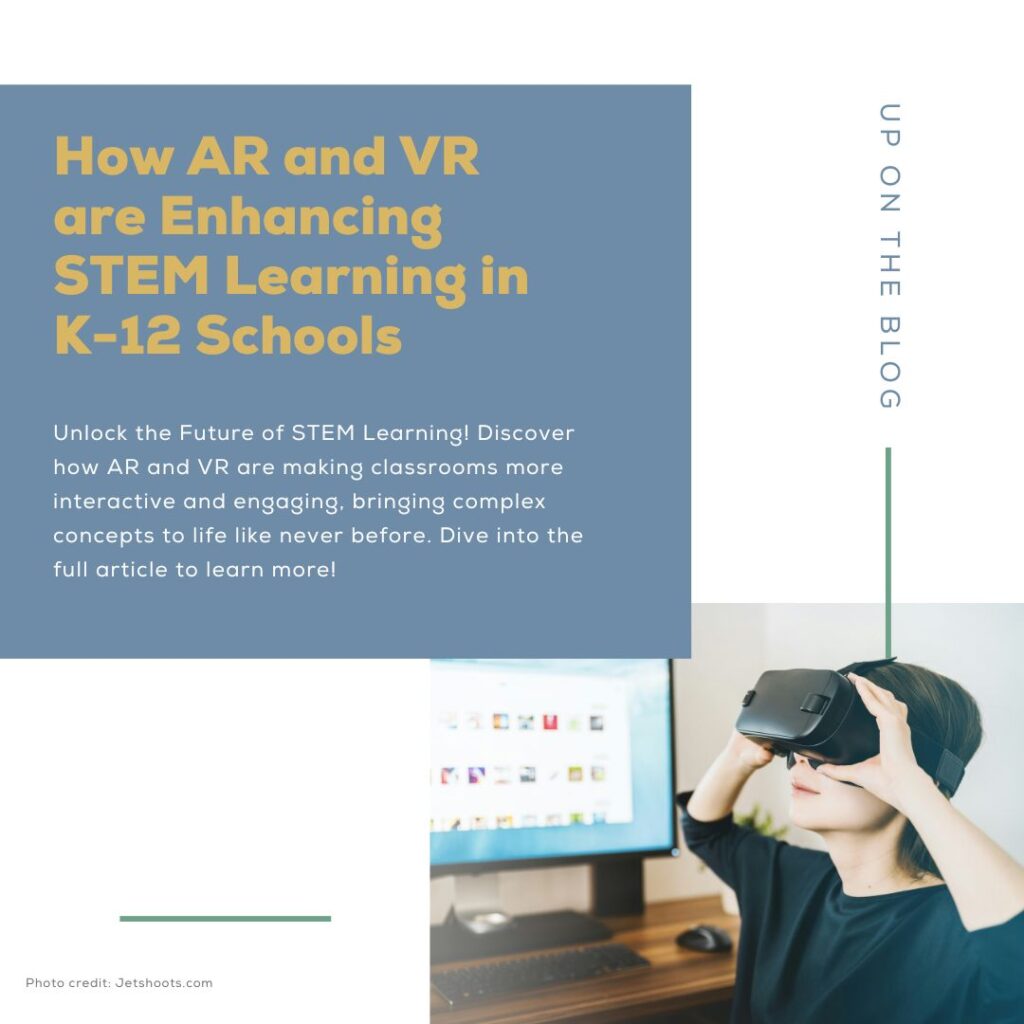
How AR and VR Are Enhancing STEM Learning in K-12 Schools
Here are some of the ways AR and VR are enhancing STEM learning in K-12 schools:
Enhanced Visualization of Abstract Concepts
It can be challenging for students to understand concepts that exist beyond what they can see with the naked eye. Exploring cell structures, atomic interactions, geological formations, and mathematical models in three dimensions gives them a clearer understanding of how these ideas work. Instead of memorizing textbook diagrams, learners can rotate objects, zoom into microscopic details, and observe systems from different perspectives.
VR in education goes a step further by placing students inside environments where they can experience scientific processes firsthand. For example, a chemistry lesson can become an interactive laboratory, while a space science lesson can place students on the surface of Mars. Activities can be adjusted for elementary, middle, and high school learners, allowing complexity to grow alongside curriculum requirements.
Immersive, Interactive Learning Environments
Platforms such as ClassVR and CoSpaces Edu allow teachers to create immersive lessons and virtual field trips where students explore ecosystems, engineering landmarks, museums, or historical locations without leaving school.
Every experience encourages curiosity through exploration rather than observation. Students actively investigate environments, answer questions, and complete challenges that reinforce classroom instruction. Hybrid classrooms also benefit from these experiences since learners participating remotely can access the same content as those attending in person. Such experiences make immersive learning a practical part of everyday instruction instead of an occasional activity.
Real-Time Feedback and Collaborative Problem-Solving
Modern AR and VR platforms do far more than create engaging visual experiences. They include built-in assessment tools that track student progress and provide instant feedback throughout learning activities.
Students working inside shared virtual spaces can solve engineering problems, conduct science investigations, and test hypotheses together. Additionally, teachers can gain insight into participation levels and learning progress while encouraging communication, teamwork, and critical thinking. These collaborative virtual environments reflect how STEM professionals work in real-world settings, where solving challenges depends on teamwork across multiple disciplines.
Bridging Classroom Learning and Real-World Application
Technology becomes an asset when students see direct connections between classroom lessons and future careers. Virtual simulations support this by allowing learners to experience engineering design, medical procedures, manufacturing processes, and environmental science in environments where they can experiment without physical risk.
Students can repeat activities multiple times, learn from mistakes, and build confidence before applying similar concepts in physical labs. Experiences like these can reduce the gap between theory and practical application while helping students appreciate how classroom knowledge connects to real industries.
Notable AR and VR Tools Used in K-12 Schools
Schools can access a growing range of platforms built to support different grade levels and learning objectives. Some of them include:
- ClassVR: Provides curriculum-aligned virtual and augmented reality experiences, including virtual field trips, interactive models, and teacher-controlled classroom activities.
- CoSpaces Edu: Enables students to build interactive 3D environments while strengthening coding skills and creative thinking.
- Merge Cube: Brings AR in education into everyday lessons by turning a handheld cube into an interactive model for geometry, biology, and earth science.
Pro tip: Schools evaluating k-12 virtual reality solutions should consider curriculum compatibility, device requirements, teacher support, and long-term scalability before making purchasing decisions.
Practical Considerations for Schools Implementing AR and VR
Successful implementation begins with careful planning rather than simply purchasing new devices. Before investing, schools should evaluate hardware costs, replacement cycles, and ongoing device management to align with available budgets. At the same time, reliable wireless coverage and sufficient bandwidth are needed to deliver smooth, uninterrupted learning experiences.
Technology alone does not guarantee successful adoption. Educators also benefit from professional development, as it gives them the confidence to integrate AR and VR into everyday lessons. Alongside teacher readiness, student safety should remain a priority, making content filtering and CIPA compliance an essential part of deployment.
With the right foundation in place, immersive learning becomes much easier to sustain over time. Thoughtful planning allows STEM initiatives to deliver engaging digital experiences while supporting practical classroom needs. In short, schools that invest in technology, infrastructure, and teacher preparedness together are better positioned to achieve lasting educational outcomes.
FAQ: AR and VR in K-12 STEM Education
What is AR in education?
AR in education uses digital content that overlays a student’s real-world environment through devices such as tablets or smartphones, making lessons more interactive while enhancing, rather than replacing, the physical classroom experience.
What is a virtual reality classroom?
A virtual reality classroom allows students to enter computer-generated environments using VR headsets, where they can participate in simulations, experiments, and collaborative activities that extend traditional instruction.
What are K-12 virtual reality solutions available for schools?
K-12 virtual reality solutions include platforms such as ClassVR, CoSpaces Edu, and Merge EDU, each supporting different curriculum goals, classroom activities, and technology requirements.
How do schools choose the right immersive learning tools?
Schools should compare curriculum alignment, ease of use, infrastructure requirements, professional development opportunities, ongoing support, and total ownership costs before selecting a solution.
Final Thoughts
AR and VR in the education sector have moved beyond emerging concepts to become practical classroom resources that boost student engagement and academic outcomes. Interactive experiences help learners visualize challenging concepts while building confidence through exploration and practice. However, strong results depend on thoughtful planning, reliable infrastructure, and the right blend of educational technology to support classroom goals.
Technology Lab partners with K-12 schools to design and support learning environments where technology serves a clear educational purpose. From assessing school needs and planning infrastructure to providing ongoing IT support, our team helps educators adopt innovative solutions that create meaningful opportunities for students while making technology easier to manage.
Schedule a free discovery call to discuss your school’s goals and technological requirements.