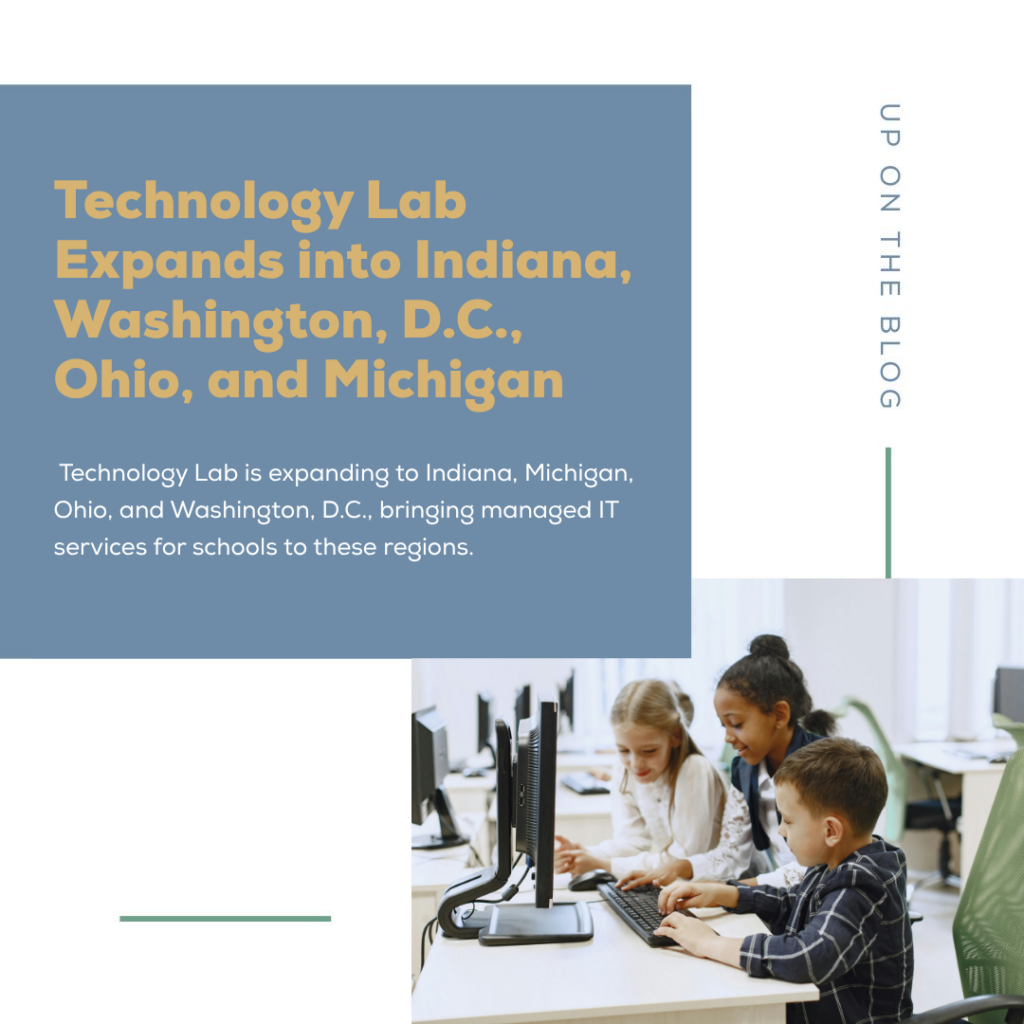
Technology Lab is expanding its K-12 technology support across Indiana, Washington, D.C., Ohio, Michigan, and Arizona, bringing its education-focused expertise to more schools and organizations nationwide. Building on its previously announced expansion into Arizona, Technology Lab is now growing its presence in four additional markets.
The expansion builds on an approach Technology Lab has developed specifically for schools: combining day-to-day IT support with security, infrastructure management, technology strategy, and long-term planning. Today, Technology Lab supports more than 300 schools and 65,000 students nationwide.
For technology leaders in these new markets, the timing is significant. The expectations placed on school IT have grown well beyond maintaining devices and responding to support tickets. Technology leaders are managing cybersecurity risk, infrastructure lifecycles, vendor relationships, cloud environments, compliance requirements, and increasingly complex technology budgets. They also need to show school leadership that those investments are producing meaningful value.
Technology Lab’s expansion gives more schools access to a partner purpose-built for that environment.
The Technology Conversation Is Changing for K-12 Leaders
Technology has become a substantial and ongoing investment for schools. That makes the quality of the technology itself only part of the equation.
IT leaders also need to understand the total cost of supporting their environment, where resources are being duplicated, which systems are approaching end of life, and how today’s decisions will affect future budgets. A purchase that solves an immediate problem can create new costs later if it doesn’t fit into a broader infrastructure and technology strategy.
Technology Lab has increasingly focused on this connection between IT performance and financial accountability. Its guidance on evaluating the true cost of school IT, for example, encourages leaders to account for expenses beyond staffing or vendor contracts, including reactive repairs, operational risk, budget unpredictability, and the cost of gaps in specialized expertise.
The same principle applies to technology planning. Equipment lifecycles, infrastructure priorities, procurement timing, available budgets, and programs such as E-Rate all influence one another. Looking at those decisions together gives technology leaders more control over what needs attention now, what can wait, and how investments fit into longer-term school priorities.
For IT leaders working within defined budgets, that level of planning helps ensure today’s technology decisions support both immediate priorities and longer-term needs.
Purpose-Built for K-12 Schools
Technology Lab was built specifically to serve K-12 schools, giving its team experience with the instructional, operational, and security demands that shape school technology decisions.
That focus influences how Technology Lab approaches managed IT services for schools.
Those needs vary considerably by school and organization. An IT leader may be looking for 24/7 help desk coverage and proactive network monitoring, specialized cybersecurity expertise, or additional capacity for an existing team. Multi-campus organizations face another layer of complexity as they work to standardize technology, while infrastructure refreshes require schools to coordinate procurement, lifecycle planning, available funding, and implementation timelines.
Technology Lab’s services span those needs, including faculty help desk support, network and device management, Google Workspace and Microsoft 365 administration, cybersecurity and compliance, student device management, data backup and recovery, E-Rate strategy, and cloud-managed network design and support.
The model can also complement an existing IT department. Technology Lab can assume responsibility for day-to-day network management, monitoring, security, and help desk support so internal technology leaders have more time for projects, planning, and educational technology initiatives.
This gives IT leaders flexibility to determine which responsibilities make sense to keep in-house and where outside expertise or capacity can strengthen the existing team.
Getting More Value From the Technology You Already Have
Accountability doesn’t always begin with a new investment. Often, it starts by taking a closer look at the environment a school already has.
Over time, technology ecosystems can become fragmented. Different needs lead to different vendors, platforms, licenses, security tools, and support agreements. Individual purchases may have made sense when they were made, but together they can create overlapping services, added administrative work, and costs that are difficult to see when each contract is evaluated separately.
Periodically evaluating the environment as a whole can reveal issues that aren’t apparent when contracts, systems, and support needs are reviewed independently. Vendor agreements, licensing, equipment lifecycles, support needs, and available funding should be considered as parts of the same technology strategy. This broader perspective can uncover opportunities to consolidate services, address recurring problems at their source, or get more from systems already in place.
It can also lead to better decisions about what comes next. A recurring repair expense may point to an equipment lifecycle issue. Multiple contracts may reveal overlapping capabilities. An upcoming infrastructure project may create an opportunity to coordinate replacement planning with E-Rate funding.
Technology Lab helps schools look across the full environment so technology decisions are informed by both immediate needs and longer-term priorities.
Looking Beyond the Purchase Price
Some of the most important returns on a technology investment aren’t captured by the purchase price alone.
A well-planned network investment can reduce disruptions and support future capacity. Stronger device management can make a growing fleet easier to secure and maintain, while effective backup and recovery can limit lost time when something goes wrong. Cybersecurity investments can reduce exposure to incidents with operational and financial consequences. All of these outcomes factor into the value a school receives from its technology investments.
Technology Lab incorporates security into its broader K-12 technology solutions, including device and network security, CIPA compliance and content filtering, dark web monitoring, phishing simulation and training, backup and recovery, and ongoing monitoring.
Security decisions affect infrastructure, staffing, budgets, and daily operations, which makes risk management an important part of broader technology planning.
Building Relationships in New Education Communities
As Technology Lab expands, the company is also investing in relationships within the education communities it will serve.
Technology Lab has added sales team members to support growth across the new territories. The company is also building relationships with education organizations in several of these markets, including the DC Charter School Alliance, Michigan Association of Public School Academies, and Indiana Charter Innovation Center.
In November, Technology Lab will attend the DC Charter School Gala and the Indiana Charter Innovation Center conference. The team will also attend the ACSA conference in Arizona on November 18, marking an important milestone in its expansion into the state. In December, Technology Lab will participate as a silver-level sponsor at the Michigan Charter School Symposium.
Those connections are an important part of entering a new market. Technology Lab’s model depends on understanding how a school operates, what leadership is trying to accomplish, and where technology can improve performance. The company’s assessment process is designed to identify those larger organizational goals and use them to inform technology strategy.
While several of these new relationships are within charter school communities, Technology Lab’s expansion will serve a broader K-12 audience, including charter, private, independent, and public schools.
Proven K-12 Expertise, Now Available to More Schools
Technology Lab’s growing presence across Indiana, Washington, D.C., Ohio, Michigan, and Arizona brings a model already supporting hundreds of schools nationwide to more K-12 communities.
For IT leaders in these markets, Technology Lab can provide comprehensive IT support or work alongside an existing team where additional capacity, specialized expertise, or strategic guidance is needed. In either case, the work begins with the school’s existing environment, priorities, and long-term goals.
As Technology Lab builds relationships across these new markets, the team looks forward to helping schools strengthen their technology environments and make informed decisions about where their investments can deliver the greatest value.
If your school is in Indiana, Washington, D.C., Ohio, Michigan, or Arizona, connect with Technology Lab to discuss how we can support your technology goals.