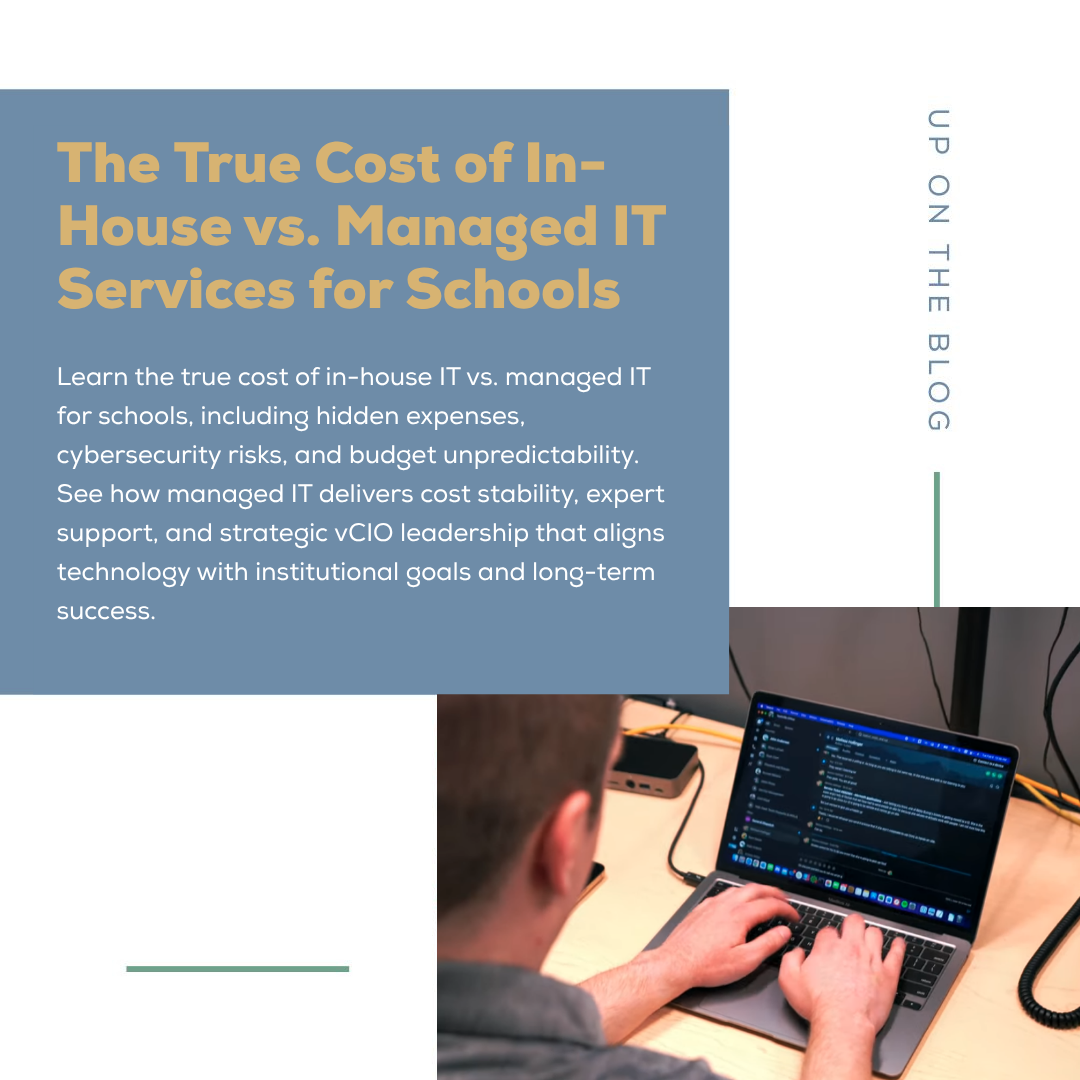
School leaders are under increasing pressure to deliver more with limited resources. Technology demands continue to expand, cybersecurity risks are accelerating, and staffing shortages make it difficult to maintain consistent IT support. At the same time, CFOs and superintendents are expected to maintain predictable budgets and justify every investment.
While maintaining an internal IT team may appear to offer control and familiarity, a closer look often reveals a more complex reality. A true school IT cost comparison moves beyond salary lines to account for hidden expenses, operational risk, and long-term inefficiencies that can quietly erode a school’s financial and operational stability.
For schools evaluating their IT model, understanding the full picture is the first step toward making smarter, more strategic decisions.
Why the IT Model Decision Matters Now
Technology is no longer a background function. It directly affects instruction, operations, security, and community trust. When IT operates reactively, the consequences compound quickly: budget inefficiencies, system instability, and growing frustration among faculty and staff.
As outlined in our IT roadmap guidance, technology decisions that are disconnected from institutional strategy often lead to overspending and underperformance. At the same time, many schools lack the staffing capacity to keep pace with increasing technical and security demands.
This creates a widening gap between what schools need from technology and what internal teams can realistically deliver. Closing that gap requires an honest assessment of both models.
The Real Cost of In-House IT
The cost of maintaining an in-house IT department extends well beyond salaries. While staffing is the most visible line item, it represents only a portion of the total financial and operational burden.
Staffing: More Expensive and More Fragile Than It Looks
Recruiting and retaining qualified IT professionals has become increasingly difficult, particularly in K–12 where compensation often cannot compete with the private sector. Even when positions are filled, turnover introduces disruption, knowledge loss, and recurring recruiting and onboarding costs. The risk is not hypothetical. One edtech consultant in Massachusetts described a situation where a departing IT employee withheld system passwords, costing the district thousands of dollars and hundreds of hours to resolve. Research confirms that about half of school districts nationwide lack the staff needed to provide adequate classroom technology support.
Limited Expertise Across an Expanding Scope
Internal IT teams are typically expected to manage infrastructure, cloud systems, cybersecurity, user support, and vendor relationships simultaneously. In most schools, a small team simply cannot provide deep expertise across all of these areas. As a result, critical functions such as cybersecurity strategy, long-term planning, and compliance oversight tend to be under-resourced or deferred entirely.
Reactive Spending and Budget Unpredictability
Without structured planning, IT spending becomes reactive. Schools are forced into emergency hardware replacements, unplanned upgrades, and urgent responses to system failures or security incidents. These events create budget spikes that are difficult to forecast and even harder to justify to boards and finance committees.
Underestimated Risk Exposure
Cybersecurity threats targeting K-12 institutions continue to increase, yet many internal teams lack the time, tools, or specialized expertise to implement proactive defenses. The FBI and CISA have repeatedly warned schools about ransomware and phishing attacks. A single incident can result in operational disruption, financial loss, and reputational damage that far exceeds the cost of prevention.
Taken together, these factors make in-house IT far less predictable, and often far more expensive, than it initially appears.
The Value of Managed IT Services for Schools
Managed IT services for schools offer a fundamentally different approach. Instead of relying on limited internal capacity, schools gain access to a structured support model backed by a full team of specialists and strategic IT leadership.
Financial Predictability
One of the most immediate benefits is cost stability. Managed IT replaces reactive, variable spending with a consistent operating model, allowing schools to forecast costs accurately and avoid unexpected expenses. This shift gives district leadership and boards greater confidence in long-term budgeting and capital planning.
Access to a Broader Range of Expertise
Rather than depending on one or two individuals, schools gain access to a team that includes help desk support, infrastructure specialists, cybersecurity professionals, and strategic leadership. This eliminates single points of failure and ensures continuity even as technology demands evolve.
Improved Operational Performance
Managed IT providers prioritize proactive monitoring, maintenance, and issue prevention. Systems are stabilized, downtime is reduced, and staff experience fewer disruptions in their day-to-day work. Over time, this translates into measurable gains in productivity and instructional continuity.
Strategic Leadership Through vCIO Services
Many managed IT models include virtual CIO services, which provide structured planning, budget forecasting, vendor oversight, and long-term roadmap development. This ensures that technology decisions are aligned with institutional goals rather than driven by immediate needs or emergencies.
Strengthened Cybersecurity Posture
With continuous monitoring, standardized best practices, and formal risk management processes, schools reduce their exposure to threats while improving compliance with insurance and regulatory requirements. For independent schools that rely on tuition revenue and donor trust, this protection is not optional.
In-House IT vs. Managed IT: A Practical Comparison
A meaningful school IT cost comparison must account for more than direct expenses. It should evaluate how each model performs across cost predictability, risk management, depths of expertise, and strategic alignment.
In-house IT often results in variable costs, limited coverage across specialty areas, and reactive decision-making driven by immediate needs. Managed IT services provide a predictable cost structure, comprehensive expertise, and a proactive approach to both operations and security.
Perhaps most important, managed IT introduces a level of strategic discipline that is difficult to achieve with constrained internal resources. Technology becomes a planned, budgeted investment rather than a recurring source of disruption and surprise.
When Outsourced IT for Schools Makes Sense
Outsourced IT for schools is particularly valuable when staffing constraints, budget pressure, and increasing complexity intersect. Schools that struggle to recruit or retain IT staff, experience frequent downtime, or face growing cybersecurity concerns often find that internal models are no longer sustainable. Similarly, institutions that lack clear technology planning or face unpredictable IT spending benefit from a more structured approach.
As we emphasized in our IT roadmap framework, moving from reactive to strategic IT is essential for long-term success. Managed IT services provide a practical and scalable path to making that transition.
Signs that your school may be ready to evaluate managed IT include:
- Difficulty recruiting or retaining qualified IT staff
- Frequent system outages or recurring infrastructure problems
- No structured multi-year technology roadmap or budget forecast
- Cybersecurity concerns without a formal risk management plan
- IT spending that is unpredictable or difficult to justify to the board
Moving from Cost Center to Strategic Advantage
The conversation around IT is shifting. The question is no longer simply, “What does IT cost?” but rather, “What value does IT deliver?”
In-house IT can be effective for larger institutions with significant resources and deep internal expertise. For many schools, however, the hidden costs, operational limitations, and risk exposure outweigh the perceived benefits of internal control. Managed IT services offer a more sustainable model that stabilizes budgets, reduces risk, and ensures that technology investments directly support institutional goals.
Explore Managed IT Services with Technology Lab
Technology Lab works with schools to assess their current IT environment, identify cost inefficiencies and risk exposure, and build a clear path toward improved performance and financial predictability.
If your school is evaluating managed IT services for schools or looking for a clearer school IT cost comparison, a focused conversation can help uncover opportunities to reduce costs, strengthen security, and improve operational outcomes.
Ready to evaluate your current IT model? Schedule a free discovery call with Technology Lab to determine whether a managed approach can better support your school’s mission and long-term sustainability.