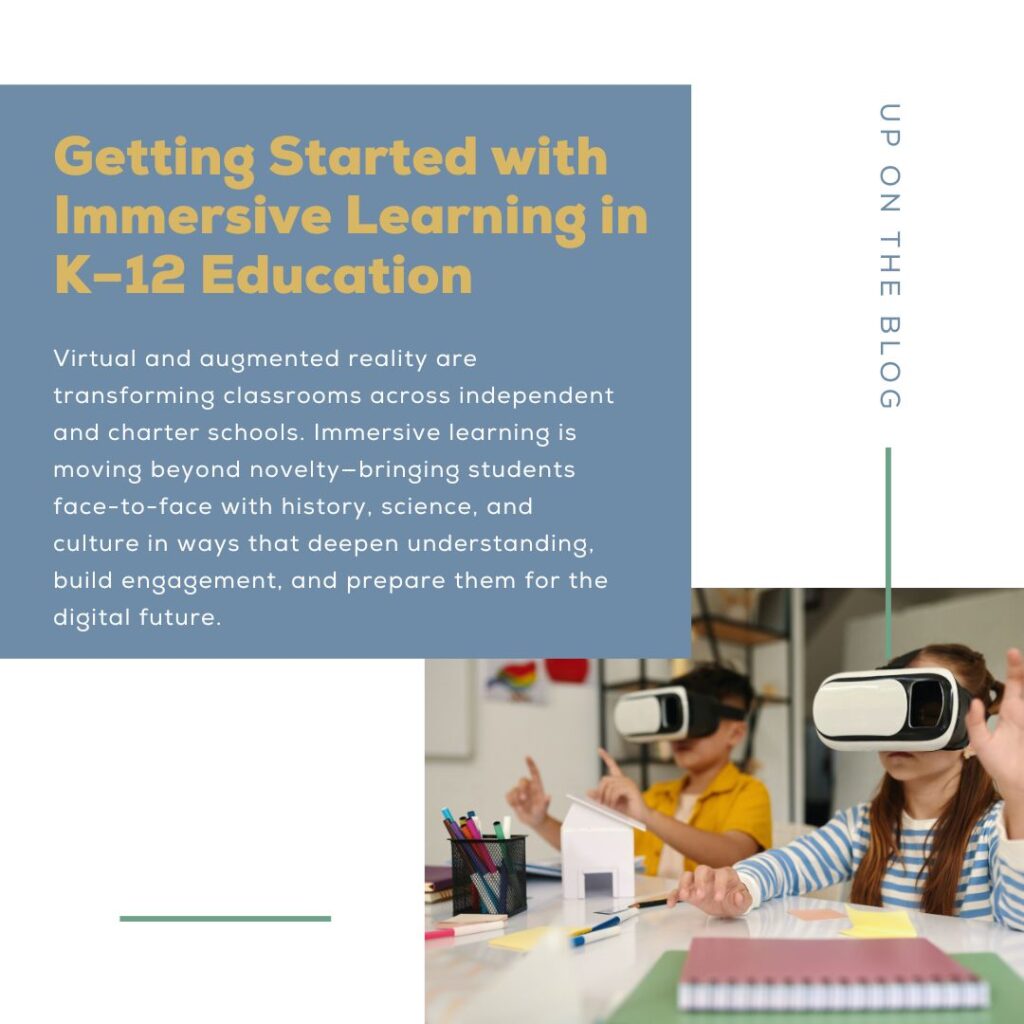
Virtual Reality (VR) and experiential learning are transforming how independent and charter schools approach teaching.
In today’s fast-evolving educational landscape, technology is no longer a “nice-to-have “—it’s becoming a critical tool for delivering engaging, equitable, and future-ready learning. Among the most promising advancements is immersive technology: VR, augmented reality (AR), and extended reality (XR). Once relegated to gaming or high-end entertainment, these tools are now entering classrooms and reshaping how students learn.
For K–12 independent and charter schools, which often have more flexibility in their approach to curriculum and innovation, immersive technology represents a unique opportunity. It brings experiential learning into everyday education, allowing students to do, not just read or watch. Whether it’s dissecting a virtual frog, walking through ancient Rome, or role-playing diplomatic negotiations, VR is turning passive learning into active exploration.
At Technology Lab, we’ve recently partnered with Optima, an educational experience company dedicated to helping educators inspire the next generation through experiential learning resources and technologies. With the world’s most extensive educational VR content library, Optima offers a broad spectrum of immersive experiences designed specifically for K–12 learners. Their offerings are designed not only to engage students but also to integrate seamlessly with classroom instruction.
Through our partnership, Technology Lab supports schools by implementing Optima’s robust suite of VR content and services, providing a full-stack approach that includes device management, teacher training, and guidance on content integration. We’re very impressed by the way Optima equips schools with the holistic resources and support they need to bring valuable experiential learning to the classroom.
Why Immersive Tools Belong in the Classroom
It’s no secret that students learn best through experience. The more interactive and multisensory a lesson, the more it tends to stick. Immersive technologies enable that level of engagement without the geographic, physical, or financial limitations that often come with hands-on learning. And these benefits are not limited to a subject or two; they can be game-changers across the curriculum:
- Science: Virtual labs can simulate chemistry experiments, dangerous physics scenarios, or even molecular biology, allowing students to explore and repeat processes safely and affordably.
- History: Rather than memorizing dates and events, students can enter history by virtually visiting a Civil War battlefield, exploring the Great Wall of China, or witnessing a pivotal moment in history through the eyes of someone who lived it.
- Languages: VR offers immersive language environments where students can interact in real-time with virtual characters or scenarios, accelerating fluency and cultural understanding.
- Soft Skills: Role-play simulations in VR can develop empathy, leadership, conflict resolution, and communication skills; all critical abilities that are often hard to teach in traditional ways.
These tools don’t just supplement learning, they can completely redefine how students relate to subjects. The emotional and cognitive impact of immersive experiences often leads to deeper understanding, long-term retention, and ownership of their learning. With Optima’s broad, diverse content catalog, educators can easily match immersive experiences to their curriculum goals, ensuring that every virtual activity reinforces academic outcomes.
4 Opportunities in Immersive Learning
These tools can optimize engagement, equity, and digital fluency in students, helping them learn material more thoroughly and equipping them for their futures.
#1 Engagement and Motivation
Immersive experiences can rekindle curiosity and motivation, especially for students who may struggle with traditional lecture-based instruction. VR captures attention in ways that books and whiteboards often can’t. Optima’s content is designed with student engagement at its core. It pairs high production value with age-appropriate, standards-aligned content intended to spark curiosity for all learners.
#2 Equity of Access
Virtual field trips democratize access to experiences. Whether it’s exploring the Louvre, swimming with marine life, or attending a rocket launch, VR brings the world to students who might never otherwise have the opportunities to leave their city or town. As a managed service provider (MSP) for schools, Technology Lab works directly with your institution to ensure equitable access by managing device procurement, connectivity, and rollout plans, especially for under-resourced or rural schools.
#3 Bridging Learning Gaps
Immersive tools support differentiated instruction. For students with learning differences or language barriers, VR can offer multisensory, scaffolded learning paths tailored to their pace and needs. Through Optima’s adaptable content and Technology Lab’s training programs, teachers can confidently use immersive tools to meet diverse student needs.
#4 Preparing for the Future
Today’s students will enter workplaces where digital fluency isn’t optional; it’s foundational. Exposure to VR and XR technologies not only enhances subject-matter learning but also builds critical digital competencies, such as spatial reasoning, data interaction, and technological confidence. By introducing immersive tech early, schools position students for success in fields like healthcare, engineering, digital media, and more.
4 Risks and Considerations in Immersive Learning
While the potential of experiential learning is promising and exciting, immersive tech also poses legitimate risks and challenges that schools must consider before jumping in.
#1 Cost
Though VR hardware is becoming more affordable, outfitting classrooms—especially at scale—can still be expensive. Add in software licenses, updates, and support, and costs can climb quickly. Optima and Technology Lab work together to streamline implementation by bundling hardware, content, and support to reduce the total cost of ownership.
#2 Scalability
A pilot program in one classroom is vastly different from district- or school-wide implementation. Schools must evaluate whether their infrastructure can handle widespread use of immersive tools. Technology Lab supports scalable deployments by aligning immersive learning tools with your school’s IT strategy.
#3 Teacher Readiness
The success of any EdTech initiative hinges on teacher adoption. Without proper training and support, even the most powerful tools may go unused or be used ineffectively. That’s why Optima provides ongoing professional development and instructional guidance, while Technology Lab offers custom training plans and in-person coaching to build confidence and competence for these new tools.
#4 IT and Data Security
VR experiences rely on strong connectivity, reliable devices, and secure networks. Student data privacy and cybersecurity must be prioritized, especially as immersive platforms collect behavioral and interaction data. Technology Lab will audit your school’s technology infrastructure to ensure secure deployment, compliance with FERPA/COPPA, and safe use of immersive technologies.
The Strategic Role of Technology Lab
Do you think your school is ready to begin integrating VR, AR, and XR, but unsure how to start? Technology Lab can help from day one. As a managed technology provider specializing in supporting independent and charter schools, we can help your institution evaluate readiness, align this new technology with curriculum, and ensure your IT infrastructure is prepared to support this kind of immersive learning.
Readiness Assessment
Not every school or classroom is ready for VR. Technology Lab can assess your current technology infrastructure—including your devices, bandwidth, and cybersecurity protocols—to help determine what’s needed for a smooth implementation. We can also help identify funding strategies and phase rollouts based on your instructional priorities.
Curriculum Alignment
A VR experience is only as good as its educational value. Technology Lab can help educators align immersive content with learning objectives, standards, and assessment strategies, ensuring that every experience is purposeful. Working in tandem with Optima, we can help create a plan that is mapped to your school’s learning priorities.
Professional Development
Investing in your teachers is just as important as investing in technology. Through workshops, co-teaching models, and ongoing support, Technology Lab can empower educators to integrate VR into their instruction confidently. In addition to Optima’s professional learning modules, we also support teachers’ onboarding and offer assistance as needed.
Iterative Piloting
Technology Lab allows schools to pilot VR programs in phases, including testing tools with small groups, collecting feedback, and refining use cases before scaling up. This approach helps minimize risk and increase the chances of long-term success. Our phased approach is flexible, collaborative, and focused on building internal champions for immersive learning.
Embracing Immersive Tech As a Tool, Not a Trend
For independent and charter schools focused on innovation, immersive learning is not just a gimmick. It’s a powerful tool for making education more engaging, equitable, and effective. But, like any tool, its value lies in how it’s used. Strategic planning, thoughtful integration, and sustained support are key to ensuring that VR and other immersive technologies truly enhance learning.
By leveraging Technology Lab to guide implementation and Optima to power instruction with meaningful content and training, schools can avoid the “shiny object” trap and build immersive learning programs that are scalable, sustainable, and centered on student outcomes.